チーム「Link∞UP」は日本と北米の‘愉快で有益な’「マウンテンライフ」情報を日本と英語圏において共有をすること。 その生活を‘一生懸命楽しんでいる人達’のコネクション強化を図ることを目的に活動しています。 日本や北米でのマウンテンライフについて情報の欲しい方や私達に興味のある方はお気軽にご連絡下さい。

ラベル Yumiko Mori の投稿を表示しています。 すべての投稿を表示

2019年4月18日木曜日

Back number Vol.165 Skiing in the harsh and gracious Japanese mountains

Looking at Mt.Shirouma from Tsugaike Shizen(Nature) Ko-en (Park)


This story was written by Kazuki Kaneiwa
   
                                                                                                              Translated by Yumiko Mori

As a backcountry skier,I always find myself feeling somehow relieved at the beginning of spring. While relishing this bizarre but comfortable feeling, I know this is an announcement for the end of the season.


Unless being asked,I wouldn't go for Mt.Tateyama in spring nor Mt. Fuji in early summer. Usually I would prepare  to work on the plateaued climbing skills and trying to lose some weights that gained during the ski season.


Personally I would say there is only a month out the a year that you can expect constant powder snow. Generally it's from mid January to mid February and this is based on a past few years of  my experience. Before that time we wouldn't have enough snow and after that the quality of the snow declines and there would be infrequent precipitation.


Otari... Oh... you ARE so amazing!!!


There are usually enough amount of snow at the lower mountains around Otari in the beginning of February. This option serves as a PlanB when we expect typical winter atmospheric pressure in Japanese Alps area. 
However, when weather permits, we head out to the Ridges of the North Japanese Alps, it significantly increase the risks and makes us feel anxious but in the end, you would be totally pleased with what your choice. 

After spending two seasons of ski bum life in Shirouma area. This fourth season is like spending times staring at weather forecast and atmospheric pressure charts on weekdays and trying to seize the best possible condition on weekends. Japanese Northern Alps and especially Shirouma is by far the my favourite area and mountain but from my home which is in the west of Tokyo, it takes 3 hours and half to get there. Furthermore, if you try to go Otari and Itoigawa, you need to add another 30 min to an hour.  Sadly, Shirouma is no longer the easy access for me.


Happou Ridge in this January


The amount of snow, weather, distance, various risks and costs are the factors that I have to take into consideration when I pick objectives. Sometime I have to scale the pros and cons and justify the objectives. 
After spending winter simply frightened by the objectives or being preoccupied in the success of the recent trips or disappointed with mistakes definitely takes toll on me. So at the end, I would be more mentally tired and ready to announce the end of the season.


Then it rains, even at the higher points in the mountains. Once the hard ice layers are formed after the rain, it will change the laying patterns completely even it is followed by another snow fall. This only makes the laying structure more unstable. Although this is in theory, sometime we've experienced the conditions not being changed after the rain. We never know truly until we actually go there.
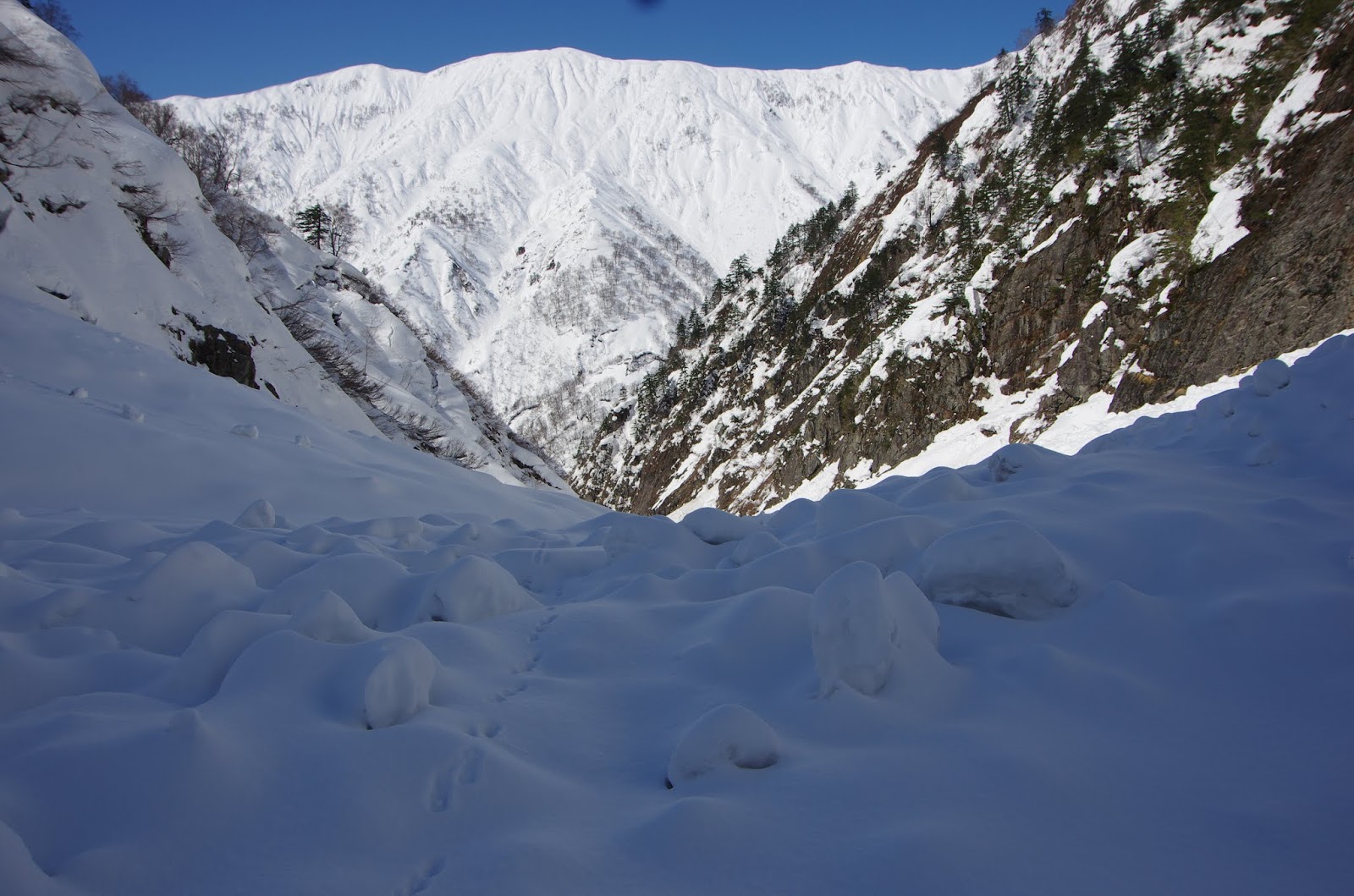


Debris at the Higura valley in Mt. Nakano

However once it rains up in the higher parts, always a huge avalanche would follow. This lead to a piles of debris in the valley. Sometimes it can cover entire valley and discourage you from skiing for the season.

Often we can achieve our objectives for the season in early spring thanks to the steady snow conditions and weather. The sense of satisfaction often prevents us from heading to backcountry skiing, feeling like "well I have already accomplished my objectives and had enough for the season. Better not to take any more risks"   


Kaerazu 2nd Ridge- up to now this is still one of the most terrifying mountains 

Mountains are intimidating.Especially the ones that have become the unsteady chunk of snow just being piled up in random layers. No matter how much you study about avalanches, gaining physical strength or skills, as long as you are in the area you won't be able to completely avoid the risk of being caught in avalanches.  If you keep on going to the same line all the time and together with extensive research, you may be able to reduce the risk significantly but what's the point of doing that...Taking the certain amount of risks and trying to manage with your skills and experiences are what makes backcountry skiing exciting.


Sometime the scary thoughts come up in my head as I prepare for the trip "Am I preparing for the death right now?" Of course this isn't the reason I go to the mountains at all. If that is the purpose, there are so many ways to accomplish it.What I am doing is preparing for the mountains so that I can come back.Some might still say that if you want to remain alive and that the objective for your thorough preparation why don't you choose "not to go at all" Well this still goes to a certain extreme point of view.  Nevertheless by choosing to continue backcountry skiing, I have nothing to say to some people consider us preparing for the early demise at least from their point of view.


The point is how you can lay out the uncertain factors and address the issues with efforts and ideas. If it's something that is above your capacity level at that time, you need to modify and find another feasible objectives. 
True alpinists are the ones while having high objectives, knowing the timing and efforts to progress to the next level. I doubt if I would ever get to that point but still I have to do my work.


My favourite tourist attraction-Daio Wasabi Farm in Azumino

Enough of the detrimental thoughts and finally I am going to summarize my points here. The momentary relief that always comes at this time of the year ties to the satisfaction from my accomplishments and self acceptance.  
However, the problem is that it is already that time of the year now but I haven't being embraced by this feelings yet. So my solution is "continue to go to the mountains" The mountains in the spring can show any faces. Although daytime gets longer and weather becomes more stable, it still does have an extreme side. For me I feel that the nature don't care about us humans at all, if they judge you are not strong enough to survive they will just sift us without hesitation.

As a powerless human, what we can do is try to remain humble and keep going back the the harsh yet gracious nature with all possible preparation. 


2019年3月22日金曜日

Back number Vol.164 Accident Report [Human Factor and Mind set]

Approach to The Maul
  This story was written by Toshiyuki Yamada 
                                                                                                  Translated by Yumiko Mori

 I still clearly remember what happened exactly at the moment. While avoiding rocks falling on me at the belaying point of the first pitch, I was ready to catch my partner that could happen any moment.   Soon after, I felt a strong pull on the rope together with my partner's scream. At the same time, I realized that there were a set of face-sized rocks falling fiercely toward me. Having already taken secure at the spot, there was no room for me to dodge so only option left for me was trying to brace my body as small as I can, hid my neck and head and pray. In a split second, a rock hit my head and I was blacked out... Luckily I recovered just after a few seconds but then another rock hit my right shin...I heard my partner shouting to see if I am okay. But the impact that I had on my shin was too strong to answer right away. The only good thing was even though I had been hit twice I still managed to hold onto the rope and remain belaying. Thanks to the adrenaline kicking in(?), the pain on my leg started to disappear and I was able to move the leg.  Knowing that I didn't fracture my leg was a big relieve for me at that time. Then I asked my partner to climb up to the anchor that caught him and take a secure.
While communicating how the situation that each of us was in, I told him that although my helmet got a huge crack,it still has served its purpose. No noticeable injury was found on my head, after touching my leg over the pants, it felt like there was some sort of cut but judging from the pain, I concluded that it should be just a minor scar without giving it a further thought.

"I can only get to go alpine climbing once a week with my current schedule" "It took four hours of approach to the line today" "Guilty for not completing the objective,going back home and giving up just after first pitch" were the few human factors and thoughts that run through my head. And to make the things worse, story of Steve House continued to climb after losing one of his shoes and Doug Scott surviving from Orga while having fractured his leg during his expedition in Pakistan somehow came up in my mind. "If I always choose to bail just because of such a small setback, I will never get to where I want to be. And this is the time I can really practice pushing my boundary, just try and see how far I can go"  This was how I decided to continued to climb...
After reaching where my partner was, we discussed our conditions (mainly our physical conditions) from very subjective point of views and agreed on continuing to climb. I remembered that Boswell's record explained that the second pitch wasn't a crux but it's got the worst protection of all pitches. After passing the halfway of the pitch, I noticed that the rock condition drastically changed, I felt almost all of the holds that I had to use seemed to be floating. From my experience, I can tolerate the risk of taking runout to a certain degree, but losing the hold that I need to use was above my skill set. This situation was exactly what Rocky's topo describes as "Catastrophe loose rock" Just a few meters before the anchor of the second pitch, the chockstone- key hold, moved and looked like it can drop anytime. At the moment, my fear of dropping this chockstone and potentially hitting my partner distracted me and I was not able to mantle. "Okay that's it for the day" I told myself and decided to climb down to the last protection which was 5 meters below. As I lowered myself, I accidentally stepped on the loose rock and it was as if I was receiving punishment of all my poor judgement for the day, I fell from the shoulder and hit hardly against the wall.

As a result, I ended up having 5 stitches on my shin, horrible bruised and frozen shoulder and (possibly fractured) ribs and whiplash on my neck.  Luckily my partner didn't have any injury from this accident.
Because of that I had to take 2 weeks off from my work. And with the plenty of spare time I had, I decided to reflect on this accident.


Thank you Millet you ARE my live saver!


The importance of the human factor and mindset

Most of the incident report tells the details of the accidents and they say that they could or should have done in this way and why they took such actions in that situation and so on. For me this is all about "What if..." therefore I am doubtful that this would serve as a tool to enhance the risk management skills. Not necessary everyone takes the same climbing style and individual's tolerance level toward the risks also vary.


I would say "human factor"-Human's behavioural pattern, in my case, it was poor decision making process, that was the culprit of causing this accident. If you have been climbing many years, you might be able to relate to this. This fall could also be attributed to the unnecessary motivation that I had. But often the case, the internal emotion and thoughts could be the main culprit but not openly shared and because of that not so many people discuss them as much as other technical or conditional aspects of the situation when we investigate the case. Most likely people would simply conclude that "he pushed too much" or "He didn't have enough skills to accomplish that line" I feel there is no room for me to argue about that kind of opinions. However that wouldn't benefit anyone, so I would like you to bear with me while going further details in this article.


You need to have an appropriate mindset to address human factors. If you are an independent climber,  researching about the route and preparing for it must be essential parts. This also means that you are expecting uncertainties=risks beforehand and preparing for them. Although this often ended up just being a theory on paper and not so useful at the actual site.
Regardless of the mental preparation, most of the behaviours and decision made in the mountains are likely to be twisted due to the relationship with your partner, your mental state, environmental condition such as weather and time. However this doesn't mean that the risk that you came up with during the preparation phase disappear. It is just the reality is far from the risk that you expected in terms of size or type. The most important thing is properly realizing and acknowledge the differences  of the anticipated risks and the what's actually happening at the moment.

We decide to go to a certain objective because the risks you anticipate would be within your skills, knowledge and experience. Or even though it's above your current level but might want to push your limit (In this case, you really need to be careful) and believe that's still manageable. This time I have already recognized the possible looseness of the rocks from the record by Greg Boswell during the preparation phase. But by actually going there I learned that its condition was way worse than I expected. It was represented by the cause of the initial fall of my partner. The rock that came off was the size of a human and as it dropped it broken into face-sized pieces. Also it was along the gully and to make the things worse, there was a sharp hike in the temperature on that day. Looking back, now I would say this was a suicidal thing and my understanding of the word "Loose Rock" got another definition.

When there is a significant gap between the estimated risk and reality at site, that means that your risk management wasn't functioning properly. For example, when the weather forecast says that there would be snow but the amount of the snowfall was more than you expected or having seen an avalanche when there was low avalanche risk.  In those cases, we need to reassess risks objectively. I believe the inherent risk of solo climbing stems from here as well. Your judgement tend to be quite subjective and you only get half of the information. By discussing and sharing opinions with partner, we can make decisions based on objective and unbiased perspectives.
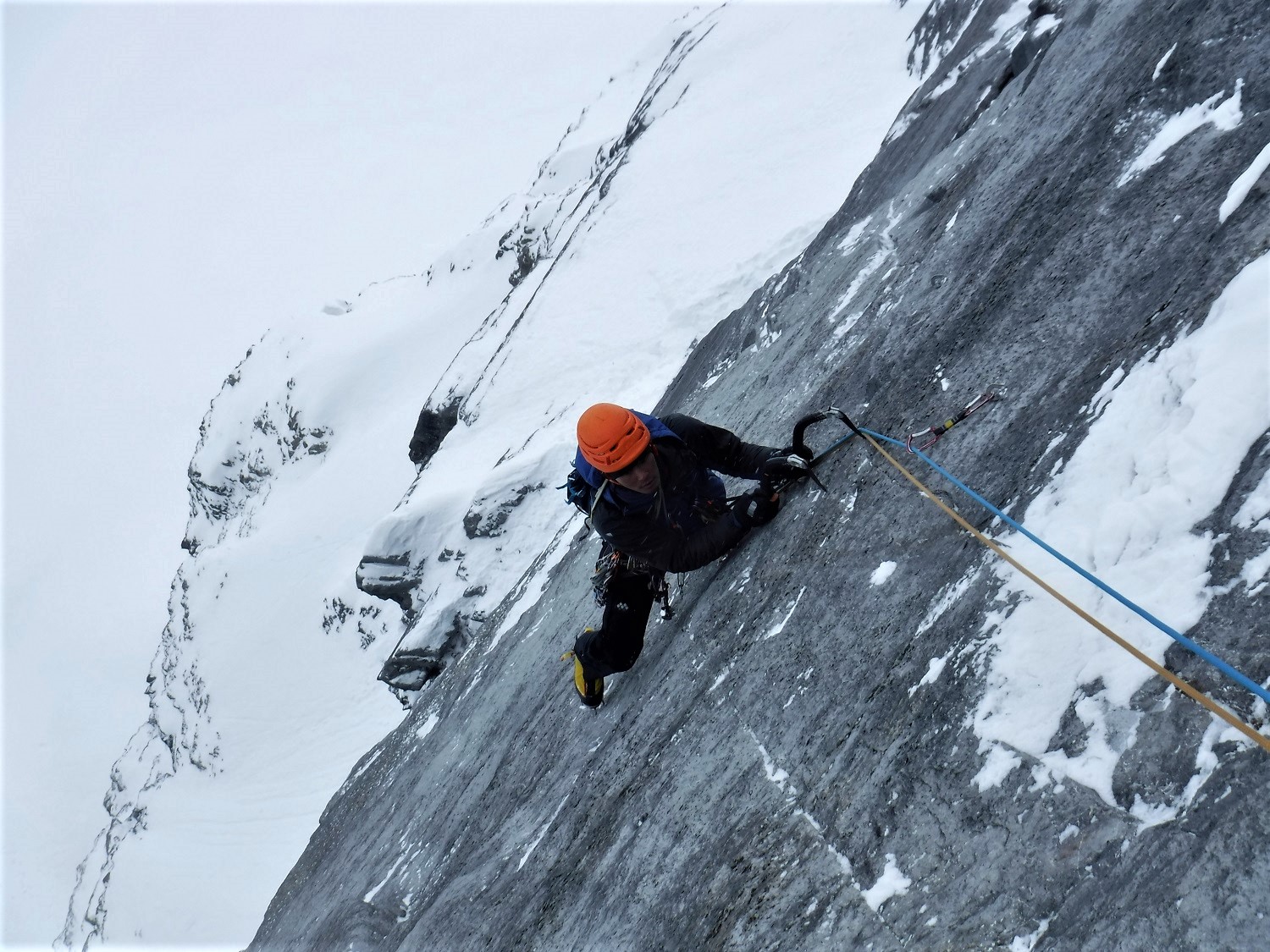


Risk is always present in the mountains 

This time we skipped important process of mindset and continued to climb. This lead us to another accident which put us in a further dangerous situation. Risk is inevitable as long as you are in the mountains and climbing also avoiding the unexpected accidents is quite hard. If you are a serious climber, there will be some occasions that you have to take a big risk. (Don't worry! This is when you go on a private one, when I am working as a Guide I wouldn't-Always safety first) Yet I am certain that as long as you catch the signals from the mountains, pause, discuss and mindset, a lots of accidents could be prevented.


I heard more accidents than previous years in the Rockies during this winter. This whole experience also made me to think about the balance of being bold and careful.
 Almost two months have passed since the accident and my body is finally fully recovered now. In April, I am planning to do a short expedition with Takeshi -Our member in the Rockies and hopefully I can share some exciting stories with you after that.


Mountains can be cruel and beautiful 

Lastly I am going to share some of the lessons that we learned from this accident.


Investigation of the incident and reflection

1.Recognition of the route condition
Like I said earlier, I knew that route can be very loose from Greg's record. It's been quite warm like Spring until February, especially the temperature was above 0 at night on the day of the accident. I could have taken the temperature into consideration but it was a rock line so didn't give it much thoughts. But obviously I should have paid attention to an idea of the ice and snow around the route could have contract the rock and warm temperature could expand the rock. Especially having contracted rock on the gully stabilize the condition and consequently lower the risk.


2.Belaying point for the first pitch

At that time I thought that my belaying point wan't a problem since I positioned myself slightly off the line that my partner was climbing and there was a overhanging rock right above me. However I should have taken a few points into consideration that as the lead climber goes up, the range of the falling rock could significantly changes and especially within a formation such as gully, the rock could hit against the wall and change falling directions completely. In this case, I should have positioned myself at the lower place.


3.Lack of communication
We should have evaluated each other's situation and made judgement objectively. Neither of me and my partner were much communicative type and we are kind of people who tend to go with flow. The important thing is that we should know each other's personality well and address the problems.
I learned that face sized rocks that hit me was initially the size of the human on our way back to the car. It was very fortunate that the rock broke into pieces as it was heading toward me and just thinking about what if it didn't break and human size rock hit me was extremely horrifying. If I heard that story before I went on the second pitch I wouldn't have continued.

4. About Gear
After the first accident, our rope was damaged and the inner part was exposed. We should check gears thoroughly not only our body after the accident. If we had a long descending with a rope like that, it could have lead to another horrible accident. Also if you climb the alpine route especially along the gully even there is a spacious ledge, in order to prevent the damage from the falling rock or ice, we should have coiled neatly and keep them close to you.

5.About Injury
When an accident occurred, make sure to check the condition of your possible injuries with your eyes. Bruises and fractures often influence the movement right away but other injury such as lacerations you don't feel the pain even though it's quite deep and severe. When the rock hit my shin, I only touched over my clothes if I had seen the actual wound I wouldn't have continued. Actually I was stunned when I first saw the condition when I got back to my car...

Thank you for reading the long story an hope you all would enjoy the safe spring climbing.

2019年2月5日火曜日

Yukon climbing report Backnumber vol.141


Fish Lake


 This story was written by Toshiyuki Yamada
                                                                                                Translated by Yumiko Mori


This summer I took almost a month break from work. It was namely for "Alpine Guide exam preparation" but I took an advantage of the situation to the most and climbed around the Rockies. It was very simple like this. Finding a project, working on and accomplishing it and then finding another projects. This routine makes me think that what I have been doing hasn't changed at all since I was a university student in Japan. But one certain thing is that I have definitely gained significant amount of experiences, skills and knowledge since then. And now I am starting to define this is my path and life is all about.


When that fun and short summer ended, my guiding company offered a great opportunity to work in Yukon for a month of October. One of the perks of being a Guide is that you get to go new places. My motto as a guide is "you need to enjoy yourself first then this attitudes lead to the satisfaction of customers" Yukon in fall attracts many tourists who are looking to grasp the beauty of leaves changing colours and aurora.  Sadly I didn't see climbers much...But my friend who is a local in the area said there are climbing areas in Yukon which is promising!! Although I only got two days off during my stay in Yukon, somehow? I managed to make three days (?) of climbing while I was in Yukon.


You won't have problems finding parking spots...

 The area called Acropolice in Yukon.  This area reminds me of Smoke Bluff in Squamish. It locates just behind the residential area.       (Photo below) 

Well stepped trail

Breathtaking view of populus trees' yellow leaves.

Impressed by the well maintained trails 

We have quite similar climbing spots like this in my hometown 

 Here the rock consists of granite. I guess the formation of the rock in the west part of Canada is granite like Squamish and Waddington.   This area was 10 minutes away from the city by car and 5 minutes approach. The walls were about 12-20m and have roughly 10 lines ranging from 5.8 to 5.12a . They've got some classic lines and even though they are short. Overall it was my first free climbing on granite wall for the last three years since I moved to the Rockies. I absolutely enjoyed the unique characteristics of the granite has.


Crucifix - signature line at the Lower Rock Garden (5.11a)


 This is another area called Rock Garden. 5 minutes by a car, 5 minutes approach and it's the closest area from Whitehorse. This becomes a venue of a climbing night hosted by ACC Yukon branch that occurs every Wednesday or Thursday evening during the summer time. Since I didn't bring cams, we did top rope climbing. For a person like me that has been so used to limestone climbing, delicate edging techniques that granite requires was refreshing.


Upper Rock Garden

 This area hosts the most difficult line in Yukon called "Yesterday's Enterprise 12c" I didn't try that line and I tried the smooth faced line "Pin Heads from space 11b" next to the line instead. But the first couple of moves were absolutely difficult so it ended almost like managing to top out somehow. Personally I found this 11b was way harder than 12a that I climbed in Acropolice area.

Nothing can go better than this combination 

Please find Yukon's climbing info http://www.climbyukon.net/

Patagonia in far north
Tombstone Territorial Park that locates 550km north of Whitehorse hosts Monolis that is also called as far north Patagonia. It isn't so popular and I haven't heard climbers going there. But for me, this place seems to be a full of possibilities.  Maybe one day I can draw a line in the area.
  
 When you get a chance to go to Yukon next time, I strongly suggest to add complete climbing gear  set to your what to bring list.


Tombstone Territorial Park

Thank you for reading!

2018年12月16日日曜日

Back number Vol.150 The truth of Alpine Climbing industry and its future

This story was written by Takeshi Tani
                                                                                                              Translated by Yumiko Mori
Finally with some snow fall in the town of the Rockies just a few days ago, it announced the arrival of the good winter season that many of us are anxiously waiting for.

Already amidst of the full on winter in the mountains, our member Bob and I tried a mix line called Dark Nutue at Lake Louise - Photo above

 Climbing is rapidly gaining popularity in Japan- maybe worldwide as it became a sport that will be competed during the Tokyo 2020 Olympics.
Although various opinions are heard, I definitely believe that having climbing gyms close by gives us great opportunity to boost the craze.
I can't help but feel the sense of envy for people who decided to start climbing at this time. When I started climbing back in Japan many many years ago, the only options were to join Alpine club in the university, community based hard core club or taught by a guide.

I would say last 10 years have shown that rock climbing field opened its door to the public more.

However the opportunities of learning alpine climbing aren't increasing yet or else declining in many countries.
The reasons can be very easy and simple. "Too many uncertain factors that alpine climbing has"
In other words, there are always dangers that you can't control and the high possibility of getting involved in the accident and lead to serious injuries or life threatening experience.


With that being said, popularity of Big Wall free climbing at Yosemite among the top climbers gives the best example in this case.While pushing your limit, you can remove as much uncertainties like avalanches, falling rocks and weather as possible. And even if you got hurt rescue is practically reachable. So there are no doubts that this field has a promise of gaining popularity.

In short, alpine climbing is an activity that you have to accept and manage all of this uncertainty.

Especially when attempting a first ascent, information like snow condition, weather and the affect of the geographical feature that you can get in preparation phase are extremely scarce. Also even minor accident during the attempt like breaking bones can lead to fatal accident.
Scary formula...Breaking bones ⇨Unable to walk⇨frostbite ⇨ hypothermia⇨death
What alpine climbers do is accepting the all possible scenarios and besides finding the best possible line at the edge of your limit.
That's why the sense of accomplishment can't be described in any easy words and makes us to pursue another new line afterwards.

 Nobody wants to lose your life.

Maybe too direct but it's definitely the truth. So if you set your mind and trying to pursue your passion for alpine climbing you will face a huge setback in finding a partner. Furthermore, there are extremely limited opportunity that you can meet someone that you can follow their steps or find any institution that offer a course of pure alpine climbing not to be an Alpine Guide.


Although alpine climbing does contain various factors and you can't entirely rely on your experiences, there is still no doubt that going mountains with experienced alpine climbers provides you with the best lessons.


As I am an Alpine Guide and not an Alpine Climber if you are striving to be an Alpine Climber and took course from a Guide like me, it might not result in meaningful experience. Rather, I would say finding someone who is an Alpine Climber and striving to make effort all the time and trying lines with them would be the best way to enhance your alpine climbing knowledge and skills.

When I was in Japan "Winter Climbers Meeting" was something that is an example of what I just said.This got its idea from UK's "Climbers Meet" and now this meeting took place every year either summer or winter alternatively.

Leading Alpine Climbers from around the world gather and interact with the local climbers.And some find their partners or next project. Sometime this opportunity lead to an amazing results in places like Himalayas.This can be said absolutely great system for aspiring Alpine Climbers.

However in order to participate in this meeting, you need to be at a certain level and it's like representing country in the alpine climbing to attend these meetings.

For people who would like to know how to reach the level, I am going to cover some of other countries approaches in terms of helping new Alpine Climbers improve their skills and abilities.


US/ Alpine Mentors

Term: 2 Years
Fee: Free
Age: It said up until 30 before but I don't see any now
Launched: 2012
Details can be seen via the link above. It's led by a known Alpine Climber and Mountain Guide Steve House.

This year, they are divided into two groups. Surprisingly they hired many Patagonia Ambassadors as an instructor and the field is worldwide. Also this programs yield many first ascents.


Slovenia /Slovenian young alpinists group        *Website not found
Term: 3Years
Fee: Unknown
Age Restriction: Unknown
Launched: 2012
10 young participants are picked from Alpine Association of Slovenia then they chose the objective by themselves. There will be a full support in terms of training, equipment and skills. This tells the strong passion for the Alpinism in Central Europe.


New Zealand/New Zealand Alpine Team
Term: 3Years
Fee: Unknown but I assume it's free
Age:  Between 18-27 
Launched: 2012

It's small group consisting of 3−4 people and they climb and ski everywhere in the world such as Yosemite, Canadian Rockies, Peru, Patagonia and Himalayas to name a few. In the application process there are some trials and looks like trad climbing skills and overall stamina occupy the major part of the criteria to pass the screening. Please refer to the link above for the further details.
 Personally I met one of the teams in the Rockies while doing ice climbing but they are exceptional...
While chatting with them, they told me that the alpine climbing community in New Zealand is also disappearing and they are desperately trying to find solutions to combat the issue and facilitate the growth of new promising alpine climbers.


Austria /Naturfeunde Alpinekader Website not found
Term: 3Years
Fee: Unknown 
Age:   Unknown
Launched 2012
First year started off with sport climbing and then winter mountaineering. From the second year, they began sending members for expeditions. Peru expedition in 2014 is also recorded as their achievement.

All the programs introduced above are launched within last 5-8 years. Sense of crisis for the declining alpine climbing field from each country can be found from this trend.

Other than that, there are Germany, France and Spain but they all took similar system.
France started in 1991, Spain in 1997and Germany in 2000. Most of them are run by its national Alpine Club of each country such as Alpine club of Germany and the programs are generally 2-3 years long. The total of 12 young members consisting of 6 males and females.

Although there are programs run by Alpine Club of Canada called "Leadership Program", to participate, you have to pay the fee and only a couple of one week long courses are currently run throughout a year.
However, there are plenty of scholarship opportunities for mountaineering and avalanche education so there are still some good aspects as well. I would dig deeper specifically about this topic some other time.


Those programs can't necessary cover the whole topics but most programs spent 2-3 years and this means they are gradually getting new young Alpinists ready for their own adventures.Above all, most of them are free and specialize in youth to support the next generation of Alpine Climbers.
Despite the common belief of in order to be stronger and good at it, you need to practice as much as you can and push your limit but in alpine climbing, things doesn't go in that way.

We can all learn from mistakes and like popular saying goes "practice makes perfect" but in alpine climbing even a small mistake can take away your life or serious consequences. So making mistakes often takes away from you doing a second shot.

Especially young people tend to push themselves than they are suppose to be and they do have that vitality to do so. That's why the relationship built through the mentoring system between young aspiring alpine climbers and experienced climbers benefit them significantly.


Just a little bit of off topic, when doing rock climbing, as long as you have solid understandings and skills, pushing your limit can be achieved practically in a easy and safe manner. Also there are plenty of learning opportunities the community like I said at the beginning.  The chance of getting hit by avalanche and falling rocks are significantly lower and even if you break bones the likelihood of dying due to the hypothermia is very slim.

Also the moves on the rocks are extremely fun and you can be creative. This is what makes differences.
Photo above: Crack climbing at Zion

When pushing your limit in the alpine ski field, almost same degrees of danger as alpine climbing accompanies. Even minor mistakes cause avalanche and you can easily lose your life. However, in terms of learning opportunity, ski industry itself has a huge community and popularity. And with the larger amount of the opportunity to be sponsored by companies together with the population of competitive skiers being significantly larger make the industry strong.

                                                                                                                 Photo above: Caribou traverse

Furthermore, in comparison, alpine climbers are always exposed to the dangerous situation whole day or even a couple of days in row but skiers are exposed to the danger less than an hour...

Nonetheless I believe alpine climbing is the very base of mountaineering and in order to reach the peak, you are required to do everything you can, accept and manage all the possible risks and dangers and overcome everything.

I am not expecting sudden blossom of alpine field, but hoping that if we can create a community in which new generation of aspiring climbers can learn and be ready for their alpine climbing.

After researching other countries' programs, I have realized again that it's truly hard to raise new generations of alpine climbers and at the same time I found myself looking for ways to support those programs in my community. To make my dream come true, I need to pursue my own alpine climbing not only my guiding skills to be an Alpine mentor.

Thank you for reading!


2018年10月1日月曜日

Back number Vol. 132 Climbing Trip in Japan

This story was written by Bob.
Translated by Yumiko Mori

Recently I got a chance to go back to Japan and spent a month.

Not being in Japan during the last three summers made me to be oblivious of how humid and hot it is during this season... Yet I am already in Japan and decided to get the most out of this opportunity...So I tried to squeeze climbing time in between and catching up with friends and indulging myself with Japanese food.

Aichi Pref Toyota city Hourai
Type ::Tuff
Access:https://www.climbing-net.com/iwaba_detail/%E9%B3%B3%E6%9D%A5/
Can be very busy during the weekedns but on weekdays you might be the only one in this area.
Avoid sunnyside but some routes in the shades provide you comfortable climbing.
I will talk about one of the signature routes called "THC" of this area at another time.

Gifu Pref Ena city Mt. Kasagi
Type:Tuff
Access:https://www.climbing-net.com/iwaba_detail/%E7%AC%A0%E7%BD%AE%E5%B1%B1/
This area also consists of tuff but also has a little hint of granite. Personally I like this area and various holds on the routes challenge you with unique moves to complete the projects.
This place was close to my place before I left Japan so all the memories came back and quite enjoyed my progress and time of reflection.
This area is higher in altitude than other climbing areas so gives you nice soothing breeze.


Yamaguchi Pref  Kameyama South
Type:Similar to Granite
Access:https://www.climbing-net.com/iwaba_detail/%E9%99%B6%E3%83%B6%E5%B2%B3/
The climbing area arround Tougatake is well known among the locals for many years. This area offered about 50 routes which was surprisingly large number in consideration of its small size.  However after the incidents of someone created holds along the most existing routes, it lost popularity.

This time my friend took me to the lead route in the southmost area of the Kameyama.

Technically this area is known for winter rock climbing so you can definitely enjoy slippery, humid and sweaty climing in the morning like I did. But luckily we were able to  continue to climb in the shades in the afternoon with much more better conditions.

Somehow this area reminded me of Kasagi (Gifu Pre) See the info above and became one of my favorite areas.
Near this place there are bouldering areas established by popular Japanese climber like Kazumasa Yoshida so it definitely worths to check out. On my way home we made a trip to the nearby hotsprings and 300g Steak.


Hokkaido Niseko 

Although we really wanted to go climbing, it was continuouslly raining all the time.
So we decided to visit the local families private climbing garage. To be honest, even though it was just for the family use but the quality was exceptional!!!!

Gozenmae Saitama
Type:Limestones
Access(#32):http://www.asahi-net.or.jp/~ca7s-kbys/area2/okumusashi1.html

It's the same type of the rocks as the Rockies in Canada but the unique formation of the rocks allowed us to enjoy diffrent kind of holds. This area is also for the winter rock climbing but depends on the area and weather we can still get to enjoy.
Note: This area has been closed for 30 years and recently reopened so please make sure to follow the rules below.
①Registration form(500yen、Need to fill out the years of experience and max grade)
②Don't forget to purchase 500yen drink as a way to pay parking fee

Yamanashi Pref   Mizugaki   Kamesari Creek
Type:Granite
Access:https://www.climbing-net.com/iwaba_detail/%E7%91%9E%E7%89%86%E5%B1%B1/

Even though all the drinking and eating while meeting up with my old friends made my body feel as heavy as an iron, but the quality time spent with friends definitely worth the feeling.


Main purpose of the visit to Japan for this time wasn't for the climbing but ended up getting to visit new or old places and tried various routes in Japan. Overall it was full of climbing during my stay.

2016 Mt.Waddington
   Enjoy Summer!!

2018年8月27日月曜日

Back number Vol 129 My opinions about the use of technology in the mountains


This story was written by Takeshi Tani                                     Translated by Yumiko Mori

In this post I will cover the topic about the use of technology in mountains.
Of course there are obvious rules, like bring back the stuff you brought in and try to limit the impact on the nature as much as you can. These are just a few examples out of common sense.

So here I am going to talk about the topic of technological devices that continuouslly being developed and appear in market.  Personally I feel some are useful and some can be aginst the concept of pure adventure.

When we are asked what is technology being used in the mountians, maybe GPS, cellphones are the items that we come up with.

Here are my thoughts about smartphone, radio, becon and In reach.


Becon
To be honest, there is nothing that can replace this amazing item.
The only reason that you go without would be to make your backpack lighter....Light and fast...? (Then do we also not bring a shovel and probe just for the sake of ligher backpack...?Really?)

Or ratehr for some people who do adventure that has higher risk of falling or doing super dangerous things than people who go for the terrain that possess the risk of avalanche might go without becon...(From Guide's point of view, I still don't recommend for not carrying it with you)

So I am strong advocate for the use of becon in the mountains! Above all, people can't find you if you got in an accident and don't carry it with you...


GPS

I guess it all depends on your skills of reading map accurately.  But GPS comes in real hand especially for ski traverse which covers great distance and also in case of whiteout. However, I still reccomend you to bring map and compass together... Don't forget to have the knowledge that actually allows you to read in case of emergency( Died battery....)


Smartphone, yes super useful item and many great map apps 


I heard some saying it only add extra weight, but for those there are watches that has smartphone and GPS  functions.  Also this is so useful to record your trip. Yet, some poeple would say just take a memo on your log book. 
One other thing I often hear is that people saying, if you rely on GPS all the time, you will lose your map reading skills. Personally I disagree with the thought and even I feel it can be opposite.

GPS and maps are necessary items


Even when I use GPS to plan a route, I still use maps at home as a part of preparation and how you read GPS is the same as you do with physical maps. So this combination makes me read maps more.

Since there are still lots of mountains that you can go without GPS, so I understand that some are reluctant to the use this technology. But for poeple who go to the mountains of flat terrains−skiing traverse, this becomes a life saver. 


In reach 

You can get GPS, Email function and furthermore, this gives you the latest weather forecast and also you can send out emergency rescue request
Spot 

This sends out your location, your safety and rescue request to the other party 


Radio and In reach, they will fall under the category of information so I am going to cover satellite phone and weather forecast here.

Radio 
Strangely many of us seem to have accepted its presence. Even the people who dislike the technology... Is that because it's being sitting there even before we do the much heated debate about technology use in the mountains??  But here I am, bringing them back onto the discussion table. 

I don't know why they don't get involved in the discussion often, there are not much differences in terms of the functions such as satellite phone or other newer inventions like Inreach.

Depends on the location, you can get the accurate weather forecast, use it as a communication tool to request for rescue. And above all this device functions with the use of battery. Yes the reason I included radio is that it uses energy that human being can't produce. So radio definitely should be called as a part of technology according to my definition. "The device that uses battery and gather information" Weather it's been there for a while or not. Let's not give them any excuses, we have to equally evaluate them together with newer devices.


Long long times ago, poeple were going into the mountains without any accurate weather forecast. The only thing that they rely on was from their experiences and observing the sky. Thinking about the  history of mountaineering is purelly fascinating.

Some go with the belief that you can use any device as much as you want until you get to the base camp and afterwards you can't...Well this seems to be vague... You can't tell what is exactlly the base camp and the definition of it are very subjective. In terms of the impact toward the nature, base camp is already in the mountains most of the case...  Some might think Okay, I am going to hire 100 skilled people to assist me to go mountains without the use of any technology... Obviously that's questionable idea as well.

Long story short, I accept the use of any devices that introduced in this post. Yet I know there are still space for discussion.


Okay then moving on to the next topic.

Approaching the mountains with the use of helicopter or Sesna. For most Japanese this concept can be the most difficult to understand and accept....Because we were grown up in the country that has paved road leading middle or sometimes to the peak of the mountain. Covered by gondola or cable cars.

Getting into the mountains with helicopter...? Isn't that cheating? But if you don't have a good access then why not. This often happens with countries of massive land. If there is no neaby town to start or any transportation in the area.

You are only going to say no to Sesna and Heli but other transportation method would be acceptable?? Then the questions continue like How about taking the Cable car at Chamonix Midi?Mountain train?Car?We can't stay at the hut?Even in the town that locates at the bottom of the mountain?Do we have to start from 0 altitude starting from the sea level?There will be never ending questions...

In Canada, there aren't much town at the bottom of the mountains so getting into the area using Sesna and Helicopter would be not unusual thing. It's quite common that the mountains are 100km away from the nearest town. In terms of the footprint, of course helicopter uses a lot of energy but when you think about how much energy and impact were given to the nature when they develop cable cars and operate them... 


We have no idea that how many years and months to be used in order to develop the cable car or set the train tracks in the mountains 


However what I can say here is that it's all depends on the mointains, the climbing style and objectives.

What I want to say is that having awareness of what you are doing, what other members are thinking and the importance of willingness to have an open discussion.
Having thought of I will do in my way no matter what or What those people are doing isn't pure mountaineering are just a few sad thoughts. As mountains lovers we should be open to other people's thinking and styles.

The tricky thing is that bringing unnecessary technology into the mountains seems to be regression but if those devices allow you to do new style of climbing or skiing, this is called progression.

The reason I talked about this is to have active conversations about mounineering.
As a guide who put the most priority on the safety. We are encouraged to bring devices that increase the safety. At the same time, as a climber, we still need to keep the pure essence of adventure.

Although there are many more devices need to be discussed, here are my opinion
Becon ◯
GPS  △
Radio, Satellite phone, In reach△(Great for emergency but if you use this for constant weather update...?)
Helicopter, Sesna △(Cable car,Gondola,Mountain train, Require further discussion along with the climbing style you prefer)


Like I mentioned a couple of time, we can't get the absolute answer. But having discussions might allow you to have completely new perspectibves and lead you to seek for pure adventures. I believe if you can ever do a single adventure that align with your thoughts, that's the most rewarding thing. And this is what all we strive for throughout the career as an Alpine Climber.

Thank you for reading.


2018年6月11日月曜日

Back number Vol.121 5 Lessons that helped me grow as an Alpine Climber

Toshi climbing up the crux of the west wall of Mt.Kidd Photo:Bob Kikuchi


This story was written by Toshi.                                                Translated by Yumiko Mori

Like the title of this post says, I felt a little improvement in my alpine climbing during this season.
Of course, I am still far from where I exactly dreamed of and there are many more routes that I wanted to try and feel I could have pushed harder. But aside from those thoughts, I still feel I have made a step forward.


Unlike sports climbing that have standardized grading system and less variable factors, it's quite hard to feel improvement in alpine climbing. Although alpine climbing still has its grade, there are too many contributing factors that can completely change the difficulty.  The condition of the wall, season, weather and partner to name a few.


Meanwhile, I assume the biggest reason why I felt the progreses comes from reflecting on and changing my approach to alpine climbing. 

So below are the 5 reasons that helped me grow as an Alpine Climber and I hope this post will help other climbers to prepare for the next season.


1.Actually doing alpine climbing 

I reasoned last year's defeat at Mt.Ball to be obvious lack of alpine climbing expericne in the Rockies.

So in order to have good results for this season I have made a plan that gradually progresses towards  a  bigger goal.

This season's record :

→North West wall of  Mt.Sir Douglas 
+
First Ascend at the Full Moon Corner 
+
West face of Mt. Kidd 

Lead to second winter time ascend of Sphinx Face at Mt. Temple 


2.Re examining the use of protection 

In hindsight, the most common reason for bailing in the Rockies is "not being able to take protections" I reflected on my climbing style and realized that I realey put on pitons during the ascend. Of course, I always carry them with me but only occasions that I used them were descending. Also I noticed that I don't carry a hammer with me. Although my beloved Nomic does have hammer, it's not something useful when you do challenging climbing.


→Below are the texts that I sent to Bob before heading to the Full Moon Corner 
 
I think we should use pitons when we climb in the Rockies. So climbing like this wall(not too big ones I mean something like Full Moon Corner) and gradually practice putting on pitons would be benefitial in the long run. What do you think?

Lately we focus too much on climbing fast and relying too much on cams and nuts.

The chance of cams to come off in the Rockies is ridiculously high. So we should come up with other ways. I always thought the difficult mountains are just purely difficult and very risky. But pitons can be an option for those cases to make it more attainable.And by doing so we can try thin ice as well. I don't think we need to change the number of cams that we use, but what I want to say is from next time make a habit of bringing a hammer and have that as an option.


From left:  Hammer purchased right after the discussion,  Pitons , Nomic

It was an absolutely right decision.Threre was nothing useful as pitons in the Rockies. When we couldn't find anywhere to take protection at base of the crux pitch of the west wall of  Mt.Kidd, we succeeded to put pitons after struggling an hour to find the best spot. This lead to the success of ascend. Likewise, at the cruxes of Full Moon Corner and Mt. Temple we used pitons. The story can be different for Granite mountains since you can find good protections but in the Rockies I relearned about the use of pitons.

( We retrieve all pitons after its use)


3.Importance of self care and conditioning

This may sound like a common sense. But the truth is that it is actually hard to do proper self care in everyday life and be getting physically and mentally ready for the big alpine climbing trip. If you are working the work caught up in you so it's a big challenge to prepare for the big climbing unless we make councious effort.

For my case, I worked 12 hours five days a week but every other week I took 3 or 4 consecutive days off.  The first day of my days off are mostly used for getting to the area and easy climbing as a warm up and actual attempt started from Day 2.


Since my job is route setting at the climbing gym, I was climbing everyday for my work. But on top of that I started to work on my weakness. So I asked my girlfriend (Personal Trainer) to write me some good customised stretch and exercise plans and followed them at home. 


 The second pitch of Man Yoga

After working on scheduling and maintenance, I felt huge improvement of my climbing performance.

At the peak of Little Snow Dorm at the Columbia Ice Filed   Training for Mt. Tmeple
4.Always picture your ultimate goal so you can become flexible


All strong alpine climbers leave results. Even though that is not something that they initially planned, they do thier best under the adverse condition pushed against them. In other words they define success as whether they are satisfied with what thety did.


For me, I was obsessed with Mt.Ball as a goal last year and as soon as I realized that I could't climb I lost all of my motivation. This winter I took 10 days off for the winter alpine climbing in the Rockies. My initial goal wasn't Temple but bacause I couldn't obtain permit we had to choose Mt.Temple which was plan C for us. The condition of the wall, weather and the fact that there were only one party that previously succeded the ascend were already tempting enough to set as a goal. And we truly switched mind to think that was the best goal for us at the time.


North face of Mt.Temple 
Red:Sphinx Face 
Yellow:The line that I climbed with Takeshi before 

5.Do not give up just because of the small adversity   

During our attemp at the Sphinx Face this time, there was a mishap happened to us. Bob's crampon got broken while climbing. 

Under that situation it was impossible to fix the crampon at the spot, we both got silent for a bit but we deceided to do a temporary fix on it by using the rope we had. At this time, neither of us used the word "bail" and we both knew we wanted to continue. This forced us to think about what we can do with what we have. If one of us said the word we would have decided to bail. The important thing is to develop skills to accurately know where we are, if it's past our limit or there is still space for us to push for the growth as an Alpine climber.


Sphinx Face 
Bob looking up at the overwhelming wall

Getting closer to the Sphinx Face Head Wall

After enduring through the crampon mishap and cold bivi, finally passing the crux 

The most popular pic for this season at my fb
At the starting point of the Full Moon Corner 
Photo by Bob Kikuchi


Topped out as the gloomy weather was starting to appear
Next year's objective may be expedition at  another country!? From the Rockies to the world. Anyways, I will keep on working on my skills as an Alpine Climber. Yet, I have to get myself ready for an Alpine Guide exam for the summer. I see my personal alpine climbing and taking an Alpine Guide exam are both adventurous in a different ways, now I am gearing up to it and spend all the energy for the exam!

Lastly, I would like to take this opportunity to thank all the support from Millet, my amazing climbig partner, friends and supportive family.